For instructors
Making Tax Digital for driving instructors: what changes in 2026, 2027 and 2028
Self-employed driving instructors are moving to digital records and a short update to HMRC every quarter. When it starts for you depends on what you took in lesson fees, and the threshold comes down every year.
By The Doovor teamUpdated 4 minute read
- United Kingdom
In short
- Making Tax Digital for Income Tax applies to self-employed driving instructors with qualifying income over £50,000 from 6 April 2026, over £30,000 from 6 April 2027 and over £20,000 from 6 April 2028.
- Qualifying income is your takings before expenses, so an instructor whose profit is far lower can still need it.
- You keep digital records and send HMRC a summary every quarter, due by 7 August, 7 November, 7 February and 7 May.
- There are no penalties for a late quarterly update in the 2026 to 2027 tax year; after that, 4 penalty points bring a £200 penalty.
What Making Tax Digital for Income Tax is
Making Tax Digital for Income Tax, MTD for Income Tax for short, changes how self-employed people keep their books and tell HMRC about them. Instead of gathering a year of receipts for one Self Assessment return, you keep digital records as you go and send HMRC a short update every quarter, using software HMRC recognises.
A quarterly update is a summary: the totals for each kind of income and expense. HMRC does not receive your receipts or invoices. You still send a tax return for the year, and you still pay your tax by 31 January after the tax year ends, as you do now.
When it applies to you
It applies once your qualifying income passes a threshold, and the threshold comes down each year:
| Qualifying income | In the tax year | You use Making Tax Digital from |
|---|---|---|
| Over £50,000 | 2024 to 2025 | 6 April 2026 |
| Over £30,000 | 2025 to 2026 | 6 April 2027 |
| Over £20,000 | 2026 to 2027 | 6 April 2028 |
HMRC checks the Self Assessment return you sent for the year in the middle column, and writes to you when you need to start.
It counts your takings, not your profit
This is the part that catches driving instructors out. Qualifying income is your total income from self-employment and property before expenses: your turnover, not your profit.
An instructor's costs are high. Fuel, insurance, the car itself and, for many, a franchise fee all come off before anything is profit. None of them comes off qualifying income. An instructor who takes £34,000 in lesson fees in the 2025 to 2026 tax year uses Making Tax Digital from April 2027, however much lower their profit is.
If you also have income from property, such as rent from a flat you let, it is added to what you take in lesson fees.
The quarterly deadlines
Each update covers the tax year so far, and is due on the 7th, about a month after its period ends:
| Update period | Send it by |
|---|---|
| 6 April to 5 July | 7 August |
| 6 April to 5 October | 7 November |
| 6 April to 5 January | 7 February |
| 6 April to 5 April | 7 May |
You can choose calendar quarters instead, from 1 April to 30 June and so on, and the deadlines stay the same.
In your first year, you still send the previous year's tax return the usual way. If you started in April 2026, your return for 2025 to 2026 is due by 31 January 2027, and your first return under the new rules, for 2026 to 2027, by 31 January 2028.
Penalties for a late update
HMRC is not giving penalty points for late quarterly updates in the 2026 to 2027 tax year, though every update still has to be sent before you can file your return. After that, each late update earns a penalty point, and at 4 points you get a £200 penalty. Points already apply to late tax returns, and penalties for paying late are separate.
What to do now
- Find your last Self Assessment return and check your turnover against the table above.
- Record every lesson payment as it happens, whether it came by card, cash or bank transfer.
- Photograph the receipt for every cost you claim, and keep it with the record.
- Choose software HMRC recognises to send your updates, or an accountant who will send them for you.
- Sign up on GOV.UK when HMRC writes to you, or before, if you would rather start early.
Where Doovor fits
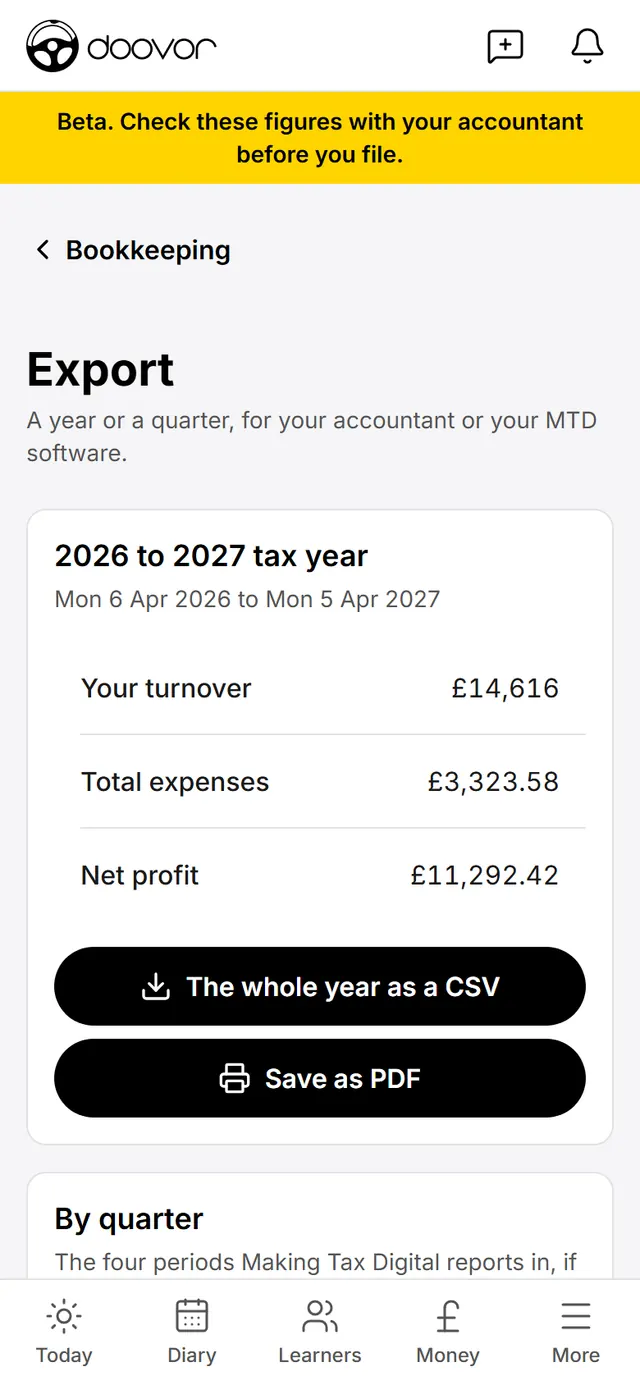
Doovor records every lesson payment as it happens, by card, cash or bank transfer, and on Pro keeps your expenses with a photo of each receipt. It exports your income and expenses by tax year and by quarter, ready for the software you send updates with or for your accountant. It does not send updates to HMRC itself. See how it works for instructors, or read how to choose driving instructor software.
This guide is general information, not tax advice. HMRC or an accountant can tell you how the rules apply to you.
Questions
- When does Making Tax Digital start for driving instructors?
- From 6 April 2026 if your qualifying income was over £50,000 in the 2024 to 2025 tax year, from 6 April 2027 if it was over £30,000 in 2025 to 2026, and from 6 April 2028 if it is over £20,000 in 2026 to 2027.
- My profit is under £30,000. Do I still need Making Tax Digital?
- It depends on your takings, not your profit. Qualifying income is your income before expenses, so an instructor who took over £30,000 in lesson fees in the 2025 to 2026 tax year needs it from 6 April 2027, whatever their profit.
- Do I pay tax every quarter?
- No. A quarterly update is a summary of your income and expenses so far. You pay your tax at the same times as under Self Assessment, with the bill for the year due by 31 January after it ends.
- I teach part time and take under £20,000. When does it apply to me?
- Not under the thresholds set so far. The lowest is over £20,000 in the 2026 to 2027 tax year, for April 2028. Keeping digital records now still makes your tax return easier.
- Can my accountant send the updates for me?
- Yes. An accountant or other agent can sign you up and send your quarterly updates for you.
Where this comes from
Checked against these pages on Mon 26 Oct 2026.
- GOV.UK: Find out if and when you need to use Making Tax Digital for Income Tax (opens in a new tab)
- GOV.UK: Work out your qualifying income for Making Tax Digital for Income Tax (opens in a new tab)
- GOV.UK: Send quarterly updates (opens in a new tab)
- GOV.UK: Penalties for Making Tax Digital for Income Tax (opens in a new tab)
- GOV.UK: Sign up for Making Tax Digital for Income Tax (opens in a new tab)
Read next
For instructors
Driving instructor expenses: what you can claim, and the rule about dual controls
Every cost you claim lowers the tax on what you earn from lessons. Here is what counts, with the one rule about your car that is easy to miss.
3 minute read, updated
For instructors
Driving instructor software: how to choose the best app in 2026
Most driving instructors now run their week from an app on their phone. Here is what good driving instructor software does, what it costs, and the questions to ask before you move your learners onto one.
7 minute read, updated