For instructors
Driving instructor expenses: what you can claim, and the rule about dual controls
Every cost you claim lowers the tax on what you earn from lessons. Here is what counts, with the one rule about your car that is easy to miss.
By The Doovor teamUpdated 3 minute read
- United Kingdom
In short
- A self-employed driving instructor can claim business costs such as fuel, insurance, repairs, the £300 ADI registration fee, a franchise fee, the business share of their phone, and advertising.
- A car with dual controls cannot use HMRC's mileage rate: claim what it actually costs to run, and capital allowances on buying it.
- Claim only the business share of anything you also use privately, and keep a log of your business miles to show how you worked it out.
- Fines, everyday clothes and the training that first qualified you as an instructor cannot be claimed.
The rule behind every claim
HMRC calls the costs you can claim allowable expenses. You can claim a cost when it is for your business. When something is used for your business and your own life, such as your phone, or a car you also drive at weekends, you can claim only the business part. If you use the £1,000 trading allowance instead, you cannot claim any expenses, which suits very few full-time instructors.
Your car: actual costs, not the mileage rate
Most self-employed drivers can choose between a flat rate for each business mile and what their vehicle actually costs. GOV.UK names dual control driving instructors' cars among the cars that cannot use the flat rates. If you teach in a car with dual controls, claim its actual costs instead:
- fuel
- insurance, including your instructor cover
- repairs and servicing
- vehicle tax
- breakdown cover
- parking
- lease or hire charges
If you also use the car for weekends and holidays, claim only the business share, and keep a log of your business miles to show how you worked it out. The cost of buying the car is claimed through capital allowances, not as an expense.
If you teach in a car without dual controls
A car without dual controls can use the flat rate. For the 2026 to 2027 tax year that is 55p a mile for the first 10,000 business miles and 25p after that; for miles before 6 April 2026 it was 45p. Once you use the flat rate for a car, you must keep using it for as long as the car is in your business, and you cannot use it for a car you have already claimed capital allowances or running costs for.
Other costs you can usually claim
- The ADI register: the fee to stay registered as an approved driving instructor, £300 every 4 years.
- A franchise fee, if you teach under a driving school's name.
- Your phone and data: the business share.
- Advertising: your website, listings and printed cards.
- Training that keeps your skills current, such as refresher courses.
- Financial costs: business insurance, bank charges, card payment fees and your accountant.
- Subscriptions to trade or professional journals.
- A uniform, if you wear one, but not everyday clothes.
What you cannot claim
- Driving that is not for your business.
- Fines and penalty charges, such as a parking or speeding fine.
- Travel between home and work. How this applies when you set off from home to collect a pupil depends on how your business is run, so check with an accountant.
- Qualifying as an instructor in the first place, which GOV.UK counts as training to start a new business.
Keep records that stand up
Record every cost as it happens, with a photo of the receipt, and keep a log of your business miles even when you claim actual costs, so the business share is easy to show. Once Making Tax Digital applies to you, digital records are required anyway.
Where Doovor fits
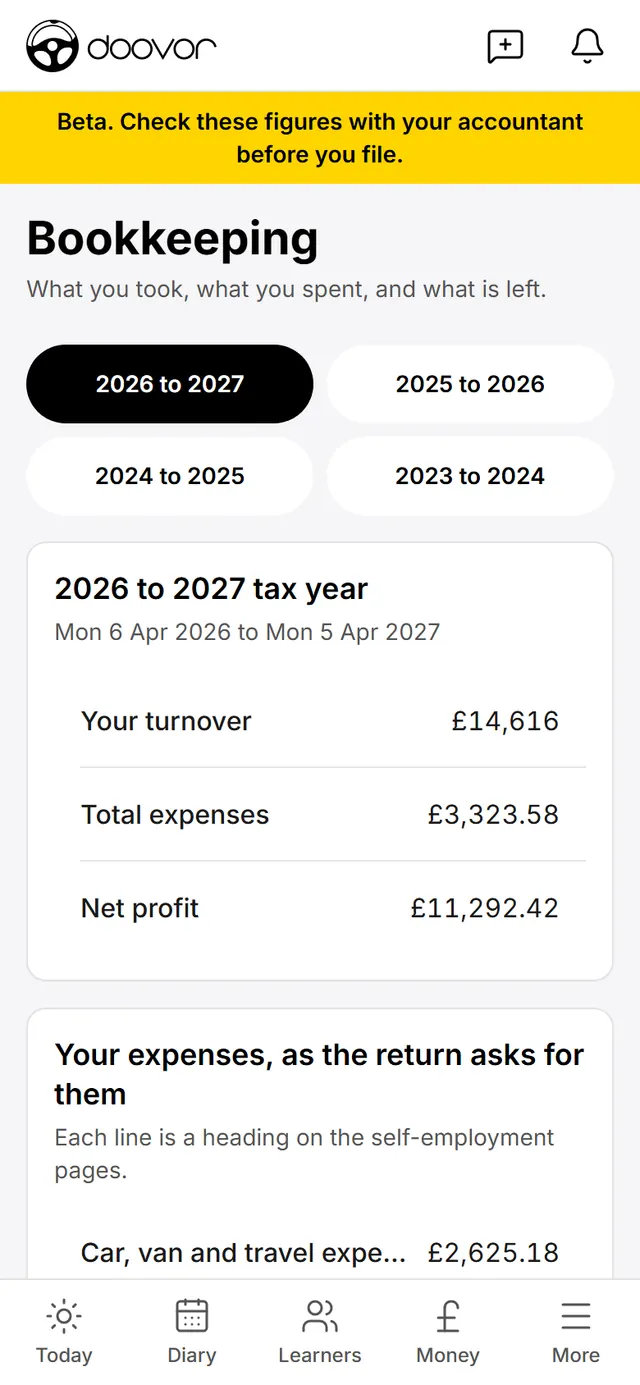
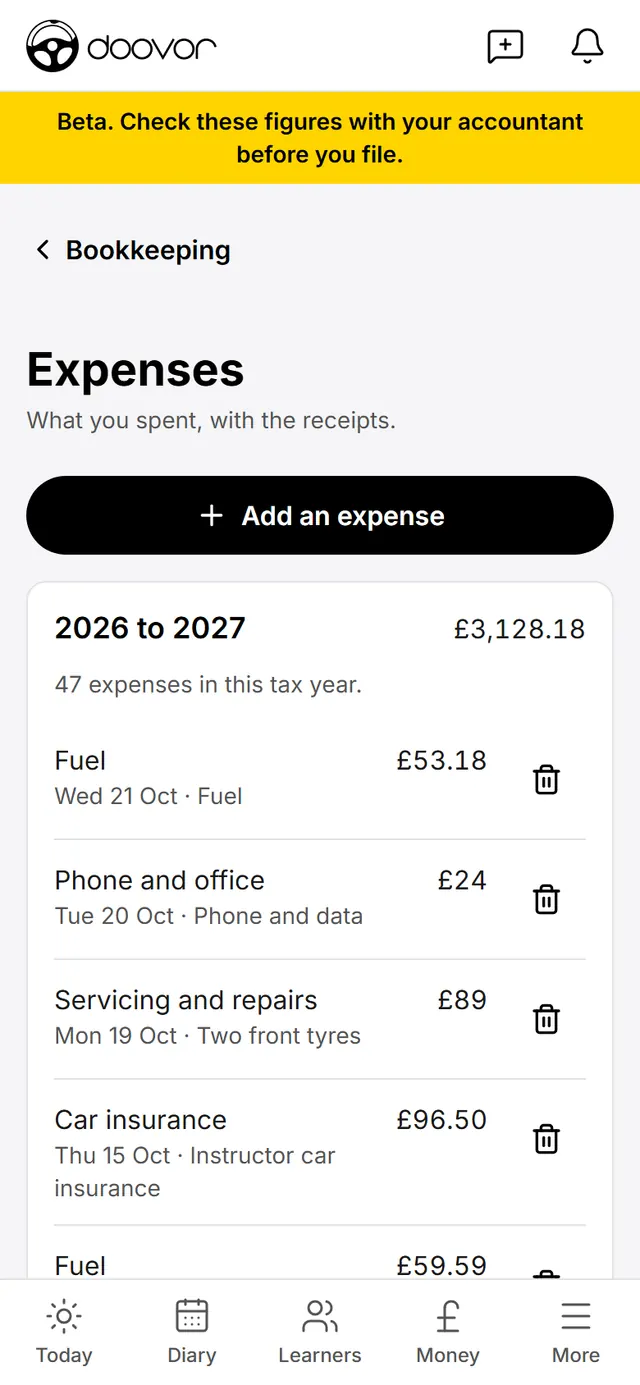
Doovor records every lesson payment as it happens, and on Pro keeps your expenses with a photo of each receipt, asks whether each car has dual controls so it is claimed the way HMRC allows, and exports your income and expenses by tax year and by quarter for your accountant. See how it works for instructors.
This guide is general information, not tax advice. HMRC or an accountant can tell you how the rules apply to you.
Questions
- What expenses can a driving instructor claim?
- The costs of running the business: fuel, insurance, repairs and servicing, vehicle tax, parking, the ADI registration fee, a franchise fee, the business share of your phone, advertising, refresher training, bank and card fees, and your accountant. Only the business share of anything you also use privately.
- Can I claim the mileage rate for my dual control car?
- No. GOV.UK lists dual control driving instructors' cars among the cars that cannot use the flat rates. Claim the car's actual running costs instead, the business share if you also use it privately, and capital allowances on buying it.
- Can I claim my ADI registration fee?
- Yes. The £300 fee to stay on the register every 4 years is a cost of your business. Keep the receipt.
- Can I claim the cost of training to become an instructor?
- Not the training that qualified you, which counts as starting a new business. Refresher courses and training that keeps your skills up to date can be claimed.
- What if I also use my car for family trips?
- Claim only the business share of its costs. A log of your business miles shows how you worked out that share.
Where this comes from
Checked against these pages on Mon 26 Oct 2026.
Read next
For instructors
Making Tax Digital for driving instructors: what changes in 2026, 2027 and 2028
Self-employed driving instructors are moving to digital records and a short update to HMRC every quarter. When it starts for you depends on what you took in lesson fees, and the threshold comes down every year.
4 minute read, updated
For instructors
Driving instructor software: how to choose the best app in 2026
Most driving instructors now run their week from an app on their phone. Here is what good driving instructor software does, what it costs, and the questions to ask before you move your learners onto one.
7 minute read, updated